
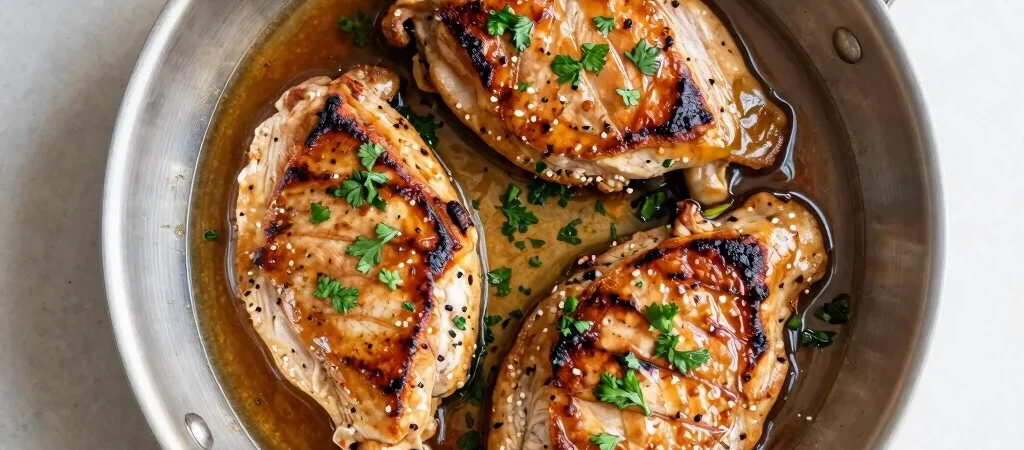
After you sear a piece of meat, the bottom of the pan is coated with browned, stuck-on bits. Cooks call this fond, and it’s concentrated flavor. A pan sauce is just a way of dissolving it into a quick sauce. It takes about 10 to 15 minutes, uses one pan, and turns plain chicken thighs or pork chops into a proper dinner.
Once you’ve done it a few times, you won’t need a recipe. This is the formula.
Jump to recipeRead the history
About this technique
A pan sauce is the fastest way to make a simple piece of meat taste like restaurant food. It turns the browned bits left in the pan into a glossy, concentrated sauce, with no extra equipment and almost no extra time.
Once you know the formula, you can improvise with whatever is in the fridge: a shallot, a splash of wine or stock, a spoon of mustard, a knob of butter.
Time 10 to 15 min · Makes sauce for 4 servings
The formula
- Sear your protein, then set it aside to rest.
- Cook an aromatic in the leftover fat: shallot, garlic, onion or mushrooms.
- Add liquid to deglaze: wine, stock, vinegar or a mix.
- Reduce until slightly thickened.
- Finish off the heat with cold butter, an acid and fresh herbs.
Ingredients for a basic version
- The pan you’ve just used to sear 4 chicken thighs, pork chops or steaks
- 1 large shallot, finely minced (about 3 tbsp)
- 1/2 cup (120 ml) dry white wine, or extra stock plus 1 tsp white wine vinegar
- 1 cup (240 ml) chicken stock
- 1 tsp Dijon mustard, optional
- 2 tbsp (28 g) cold unsalted butter, cut into small cubes
- 1 to 2 tsp lemon juice
- 1 tbsp chopped parsley or thyme
- Salt and pepper
Method
- Sear the meat in a stainless steel or cast-iron pan. Non-stick pans don’t build a good fond. Move the meat to a plate and cover loosely.
- Tip out all but about 1 tablespoon of the fat. If the browned bits are dark brown, that’s good. If they’re black and burnt, wipe the pan out and start with fresh oil.
- Turn the heat to medium. Add the shallot and cook for about a minute, stirring, until soft.
- Pour in the wine and scrape the bottom of the pan with a wooden spoon. Simmer for 2 minutes, until reduced by about half.
- Add the stock and mustard, if using. Boil over medium-high heat for 4 to 5 minutes until reduced by half again and the sauce lightly coats the back of a spoon.
- Take the pan off the heat. Swirl in the butter one cube at a time until each melts. Cold butter helps the sauce become glossy and slightly creamy.
- Stir in the lemon juice, herbs and any juices that collected under the resting meat. Taste and season. Spoon over the meat.
Why it works
Wine and stock dissolve the fond, and reducing concentrates the flavor. Butter added off the heat forms an emulsion, meaning the fat and liquid stay blended together. If the pan is too hot when you add it, or the butter is too warm, the sauce can separate and look greasy.
Variations
- Mustard cream: add 1/4 cup of cream with the stock and finish with a spoonful of grainy mustard.
- Mushroom: cook sliced mushrooms until browned before adding the shallot.
- Balsamic shallot: use red wine and finish with 1 tbsp balsamic vinegar.
- Orange and thyme: replace half the wine with orange juice. This goes well with pork and duck.
Troubleshooting
- Sauce is too thin: keep reducing before adding the butter.
- Sauce is too salty: it’s easy to over-reduce store-bought stock. Add a splash of water or a little more butter.
- Sauce split or looks oily: take it off the heat, add a spoonful of water and whisk hard.
- Sauce tastes bitter: the fond was burnt. Next time, lower the heat while searing.
Storage
A pan sauce is best fresh. If you have leftovers, keep them for up to 2 days in the fridge and reheat gently, adding a splash of water.
Where the technique comes from
Deglazing a pan to make a sauce is a fundamental part of French cooking. The French word for it, déglacer, and the term monter au beurre, meaning to enrich a sauce with butter, are still used in professional kitchens. Auguste Escoffier’s Le Guide Culinaire, published in 1903, helped set out the rules of classic French sauces.
A classic sauce could take hours. A pan sauce is the home and restaurant shortcut: the same principles, using what’s already in the pan, in a few minutes.
The French word fond simply means base or foundation, and it’s an accurate name: the browned layer on the bottom of the pan is the foundation of the sauce. Professional kitchens have used the technique for generations, and it is one of the first skills taught to new cooks.