You don’t need a smoker for good ribs. You need low heat, enough time, and a sauce that goes on at the end. The oven handles the first two. This method wraps the ribs in foil, which traps steam and breaks down the tough connective tissue until the meat is tender but still has some bite.
The rub here is sweet, smoky and a little spicy. Make it the night before if you can.
Jump to recipeRead the history
About this dish
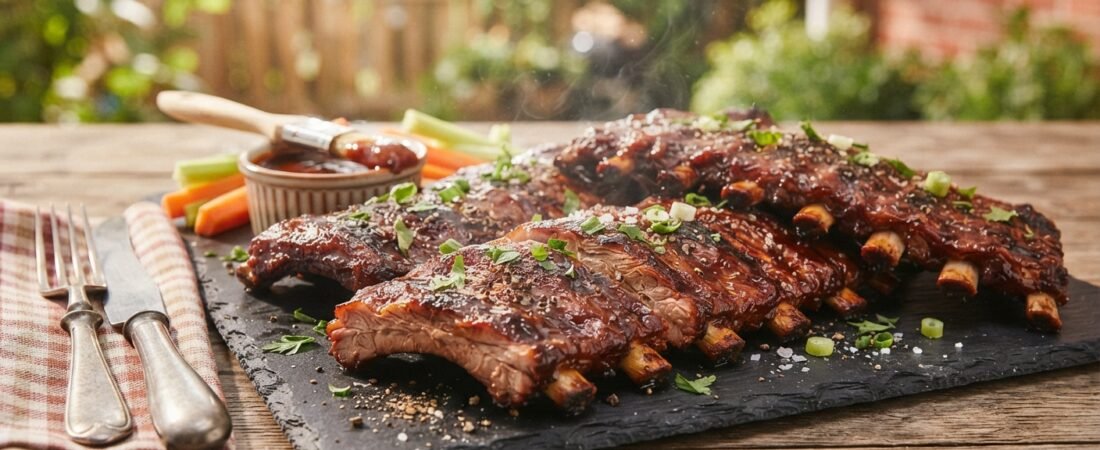
These ribs are tender, sticky and smoky-sweet, with a dark caramelized glaze. The long, slow bake turns tough meat soft enough to pull cleanly from the bone, and a hot finish at the end sets the sauce into a lacquer. A good rib still has a little bite, so don’t expect mush.
Serve them with coleslaw, cornbread, baked beans or corn on the cob, and plenty of napkins.
Prep 20 min plus resting · Cook 3 hours · Serves 4 to 6
Ingredients
Ribs and dry rub
- 2 racks baby back ribs (about 2 to 2.5 lb / 1 to 1.1 kg each)
- 3 tbsp brown sugar
- 2 tbsp smoked paprika
- 1 tbsp kosher salt
- 2 tsp garlic powder
- 2 tsp onion powder
- 1 tsp black pepper
- 1 tsp mustard powder
- 1/2 tsp cayenne
- 2 tbsp apple juice or water, for the foil packets
Quick BBQ sauce
- 1 cup ketchup
- 1/4 cup apple cider vinegar
- 1/4 cup brown sugar
- 2 tbsp molasses
- 1 tbsp Worcestershire sauce
- 1 tsp smoked paprika
- 1/2 tsp garlic powder
- Pinch of salt
Method
- Turn the ribs bone-side up. Slide a butter knife under the thin membrane on the bones, grip a corner with a paper towel and pull it off in one piece. It’s tough and blocks the rub.
- Mix the rub ingredients in a bowl. Pat the ribs dry and coat both sides generously. Let them sit for 30 minutes at room temperature, or wrap and refrigerate overnight.
- Heat the oven to 275°F (135°C). Place each rack on a large sheet of foil, add 1 tbsp apple juice, and wrap tightly into a sealed packet. Set the packets on a baking sheet.
- Bake for 2.5 hours. Open a packet carefully to check. The meat should have pulled back from the bone ends by about 1/4 inch, and a rack held in the middle with tongs should bend easily and start to crack on the surface.
- While the ribs cook, simmer the sauce ingredients in a small pot for 10 minutes.
- Raise the oven to 425°F (220°C). Unwrap the ribs, place them on the baking sheet, and brush with sauce. Bake for 10 to 15 minutes, brushing again once, until sticky and lightly charred at the edges.
- Rest for 10 minutes, then cut between the bones.
Tips
- Take the membrane off. It’s the most common reason homemade ribs turn out chewy.
- Sauce goes on at the end. The sugar in it burns during a long bake.
- Judge by feel, not the clock. Ribs are tender at roughly 195 to 203°F (90 to 95°C) inside, but the bend test is easier.
- Save the juices that collect in the foil. Spoon a little over the sliced ribs, or stir into the sauce.
Storage and reheating
Leftover ribs keep for 4 days in the fridge. To reheat, wrap them in foil with a splash of water or apple juice and warm at 300°F for 20 minutes. Finish with a fresh coat of sauce.
Variations
- St. Louis-style spare ribs work the same way, but add 30 minutes to the foil stage.
- Skip the sauce and serve the ribs dry, Memphis style, with sauce on the side.
- Finish on a hot grill instead of the oven for 5 minutes a side to get real char.
A bit of barbecue history
Slow-cooking meat over low heat is one of the oldest cooking methods there is. The English word barbecue is generally linked to barbacoa, a word recorded by Spanish explorers in the Caribbean for a wooden frame used to cook meat over fire. In the American South the practice developed around pork, which was cheap and plentiful, and tough cuts such as ribs and shoulder suit long, slow cooking.
Regional styles settled in over the 19th and 20th centuries. Memphis is known for pork ribs with a dry rub. Kansas City for a thick, sweet tomato sauce. The Carolinas for vinegar-based sauces, and Texas for beef brisket. Barbecue in each place reflects the local meat, wood and the communities who developed it, including a large contribution from Black pitmasters. The oven version here is a shortcut, but the principle is the same: low heat, patience, and a good glaze.
Pork ribs are the classic in most of the United States, but beef ribs are the star in Texas. Korean and Chinese cooking have their own glazed rib traditions, such as galbi and char siu-style spare ribs, so the idea of sweet, sticky ribs is a global one.