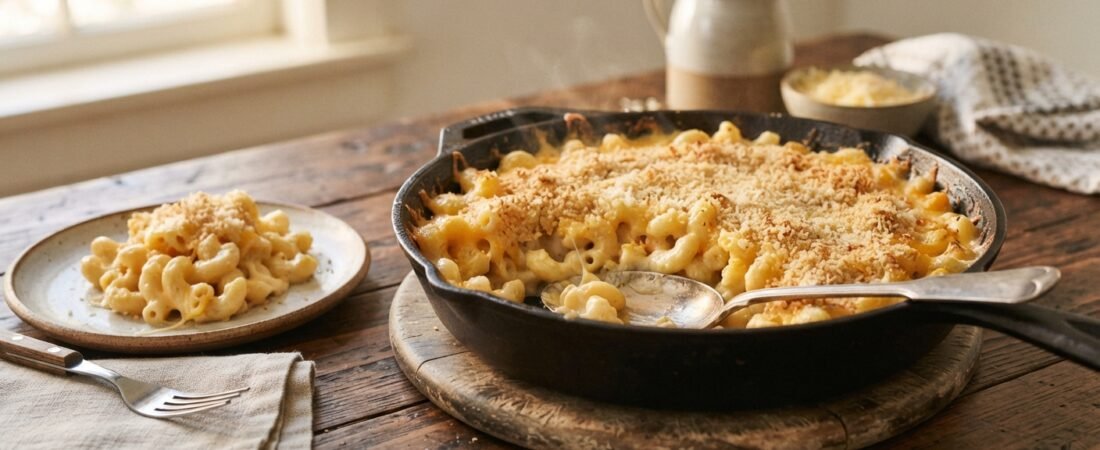
Good mac and cheese comes down to the sauce. A smooth, well-seasoned béchamel with real cheese melted into it will beat any shortcut. Add a crisp, buttery topping and you have the version people ask for again.
This one uses sharp cheddar for flavor and Gruyère for melt. Grate both yourself. It matters more than you’d expect.
Jump to recipeRead the history
About this dish
A creamy cheese sauce made with sharp cheddar and nutty Gruyère, folded through tender macaroni and finished with a crisp buttered crumb on top. The sauce is silky rather than stringy, and the baked topping gives you the crunch that stovetop versions lack.
It works as a side dish on a holiday table or as a main course on a weeknight. Either way, leftovers don’t last long.
Prep 20 min · Bake 30 min · Serves 6 to 8
Ingredients
Pasta and sauce
- 1 lb (450 g) elbow macaroni
- 4 tbsp (55 g) unsalted butter
- 1/3 cup (45 g) all-purpose flour
- 3 cups (720 ml) whole milk, warmed
- 1/2 cup (120 ml) heavy cream
- 1 tsp mustard powder
- 1/4 tsp cayenne or paprika
- 1 1/2 tsp salt, plus more to taste
- 1/2 tsp black pepper
- 12 oz (340 g) sharp cheddar, freshly grated (about 3 cups)
- 4 oz (115 g) Gruyère, freshly grated (about 1 cup)
Topping
- 1 cup (60 g) panko breadcrumbs
- 2 tbsp melted butter
- 1/4 cup (25 g) grated Parmesan
Method
- Heat the oven to 375°F (190°C) and butter a 9 by 13 inch baking dish.
- Cook the macaroni in well-salted boiling water for 2 minutes less than the package directs. It will finish cooking in the oven. Drain and set aside.
- In a large pot, melt the butter over medium heat. Whisk in the flour and cook for 1 minute without browning.
- Slowly pour in the warm milk, whisking all the time, then add the cream. Simmer for 5 to 6 minutes, stirring, until the sauce coats the back of a spoon.
- Take the pot off the heat. Stir in the mustard powder, cayenne, salt and pepper, then the cheeses in three batches, letting each melt before adding the next. Save 1/2 cup of cheddar for the top.
- Fold in the macaroni until coated. Taste, and add more salt if needed. The sauce should taste slightly over-seasoned, since pasta absorbs it.
- Pour into the baking dish. Mix the panko, melted butter and Parmesan, then scatter it over the top along with the reserved cheddar.
- Bake for 25 to 30 minutes, until bubbling and golden. Let it stand for 10 minutes before serving so the sauce thickens.
Tips
- Grate your own cheese. Pre-shredded cheese is coated with starch to stop it clumping, and it can make the sauce grainy.
- Don’t add cheese over high heat. Too much heat makes it greasy and stringy.
- Undercook the pasta slightly. It keeps absorbing sauce in the oven.
- Warm milk goes into the roux more smoothly than cold, with fewer lumps.
Storage and reheating
Keeps for 4 days in the fridge. Reheat individual portions in the microwave with a splash of milk, or warm a whole dish covered with foil at 325°F for 20 minutes. It can be assembled a day ahead, without the topping, and baked straight from the fridge with an extra 10 minutes in the oven.
Variations
- Stir in crisp bacon, roasted broccoli or chopped pickled jalapeños.
- Swap the Gruyère for fontina, Monterey Jack or smoked Gouda.
- Skip the oven for a stovetop version. Stir the cooked pasta into the sauce and eat it straight away.
A brief history of mac and cheese
Pasta baked with cheese is old. A 14th-century English cookbook, The Forme of Cury, includes a recipe for noodles layered with cheese, and similar dishes show up in Italy around the same time. The idea reached America with European settlers, and by the 18th century it was a dish for special occasions.
Thomas Jefferson is often credited with popularizing macaroni and cheese in the United States after tasting pasta in Europe. His enslaved chef James Hemings trained in Paris and almost certainly played a large part in preparing it. The dish became an everyday food in the 20th century, helped along by the boxed Kraft Dinner introduced in 1937, which made it cheap, quick and popular during the Depression and wartime rationing.
Pasta and cheese baked together has relatives around Europe, including Swiss älplermagronen, which adds potatoes and onions, and the many Italian baked pasta dishes with cheese. The American version, built on a béchamel base, is the one that spread through home kitchens and later into the boxed product.